

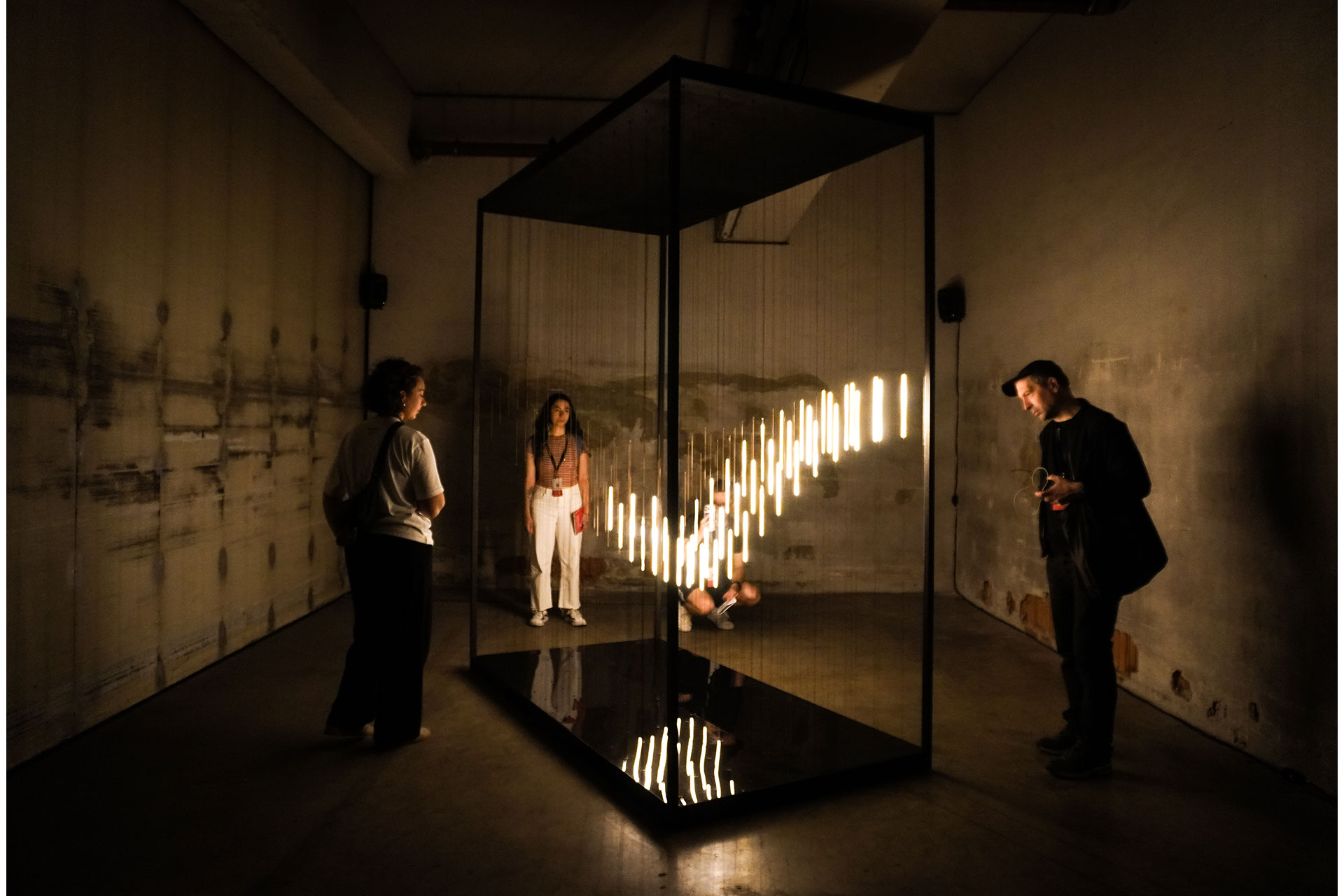
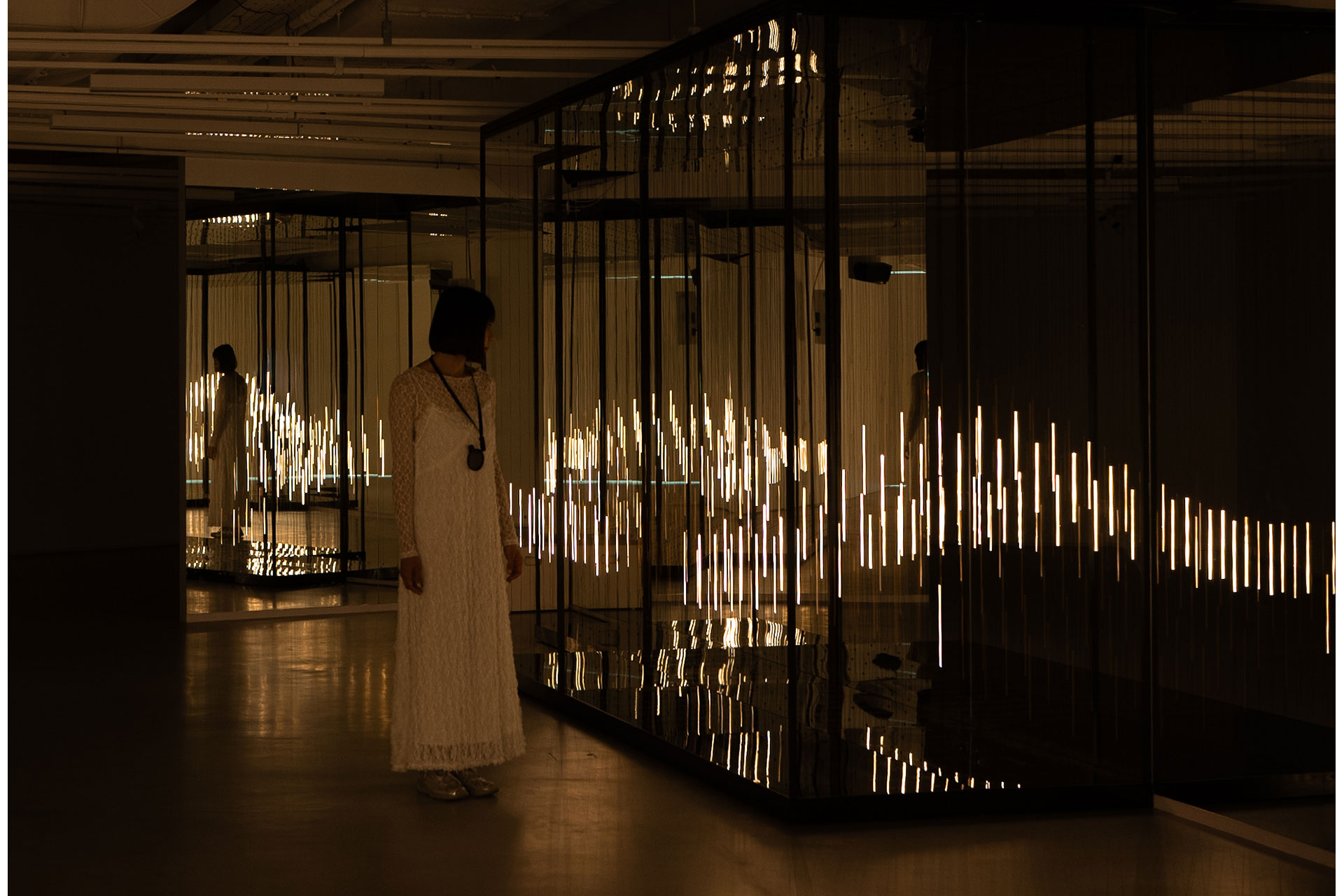
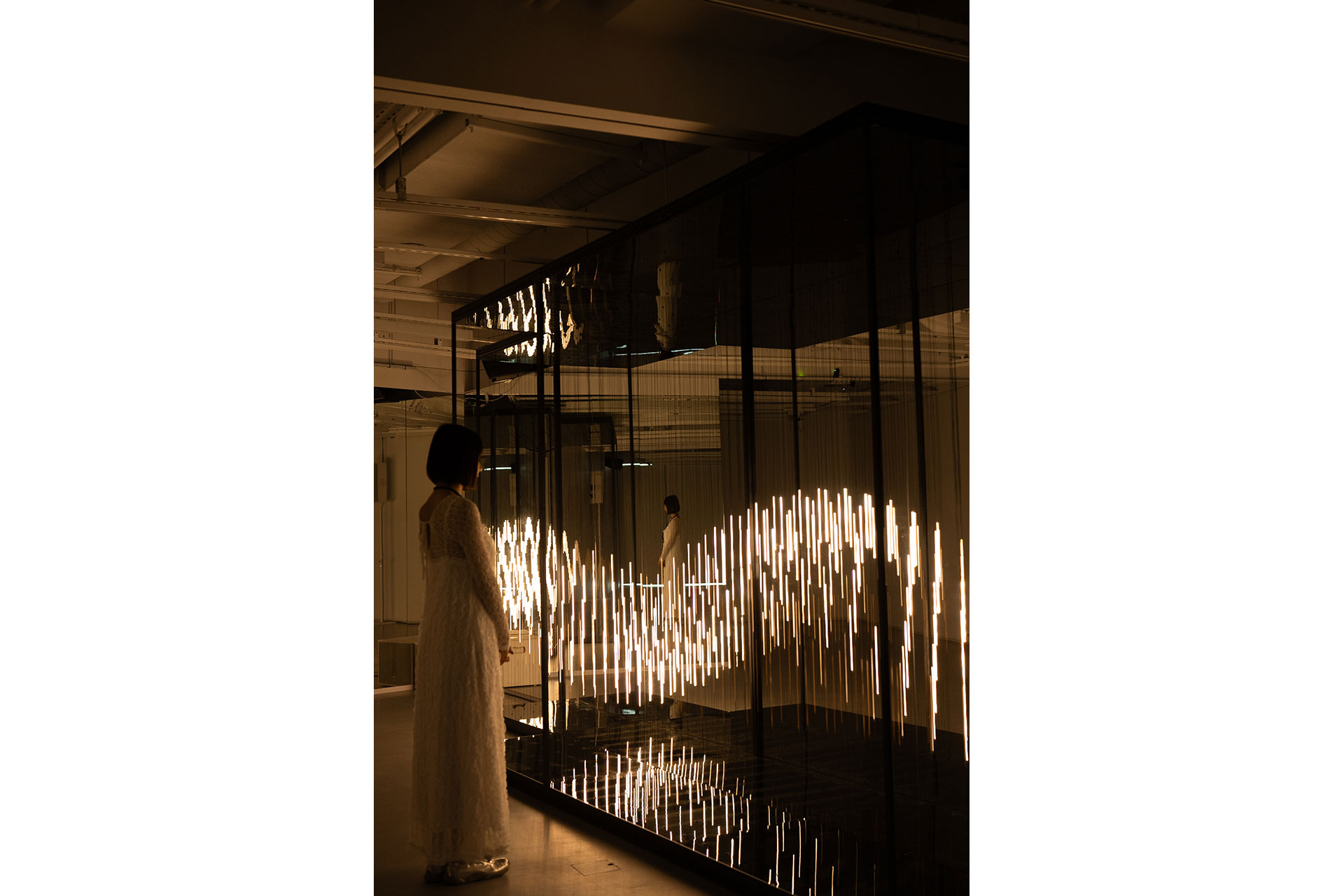
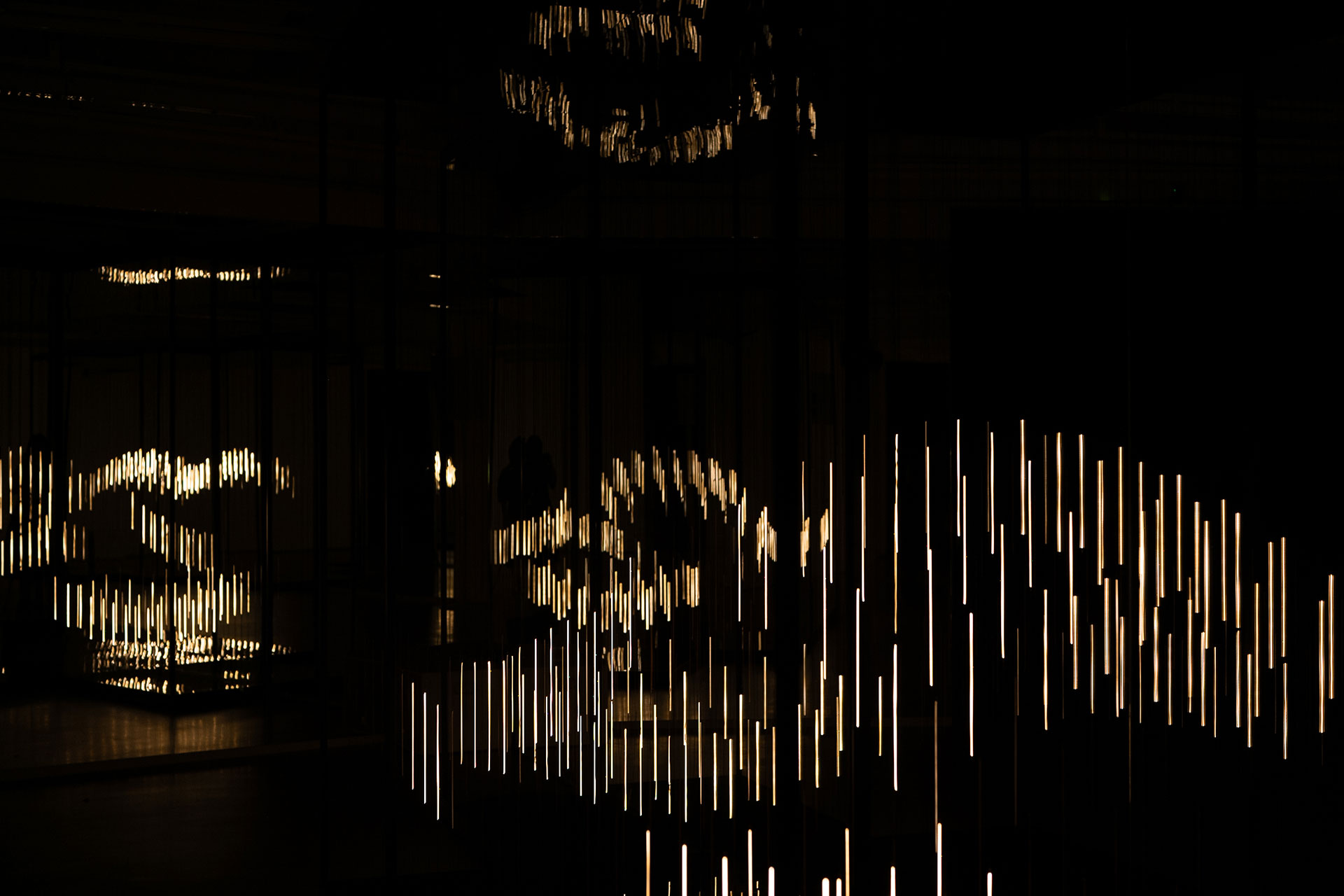
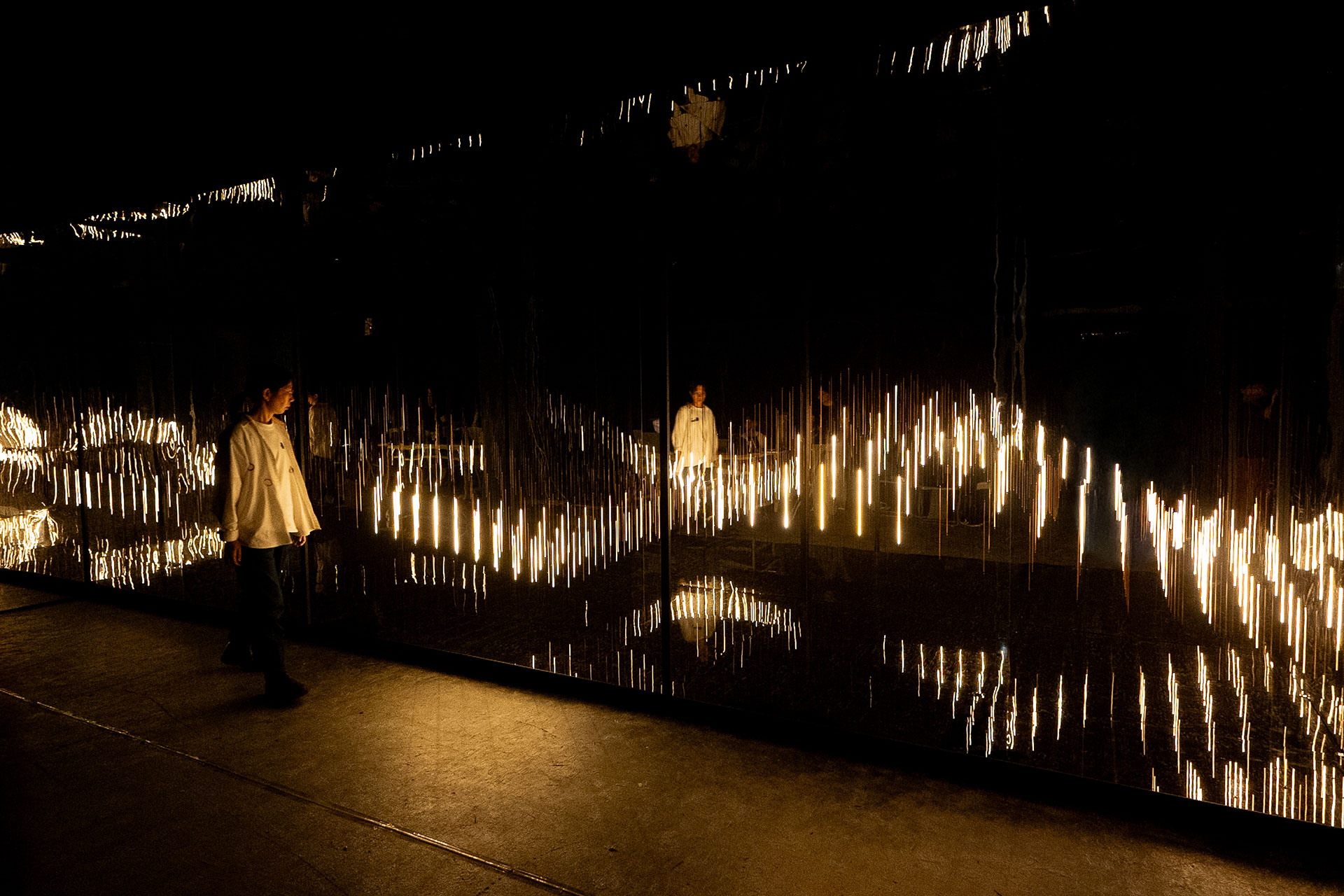
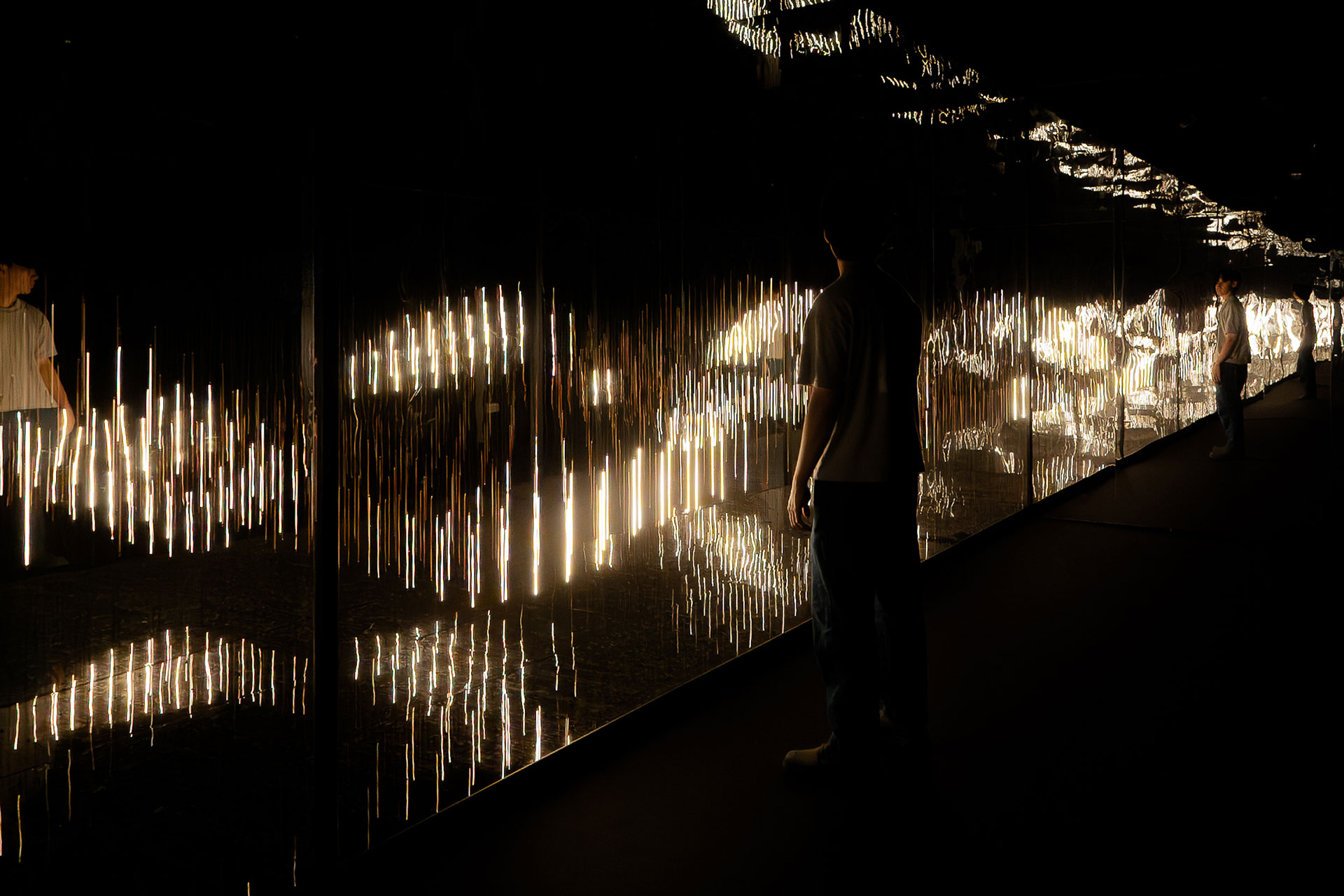
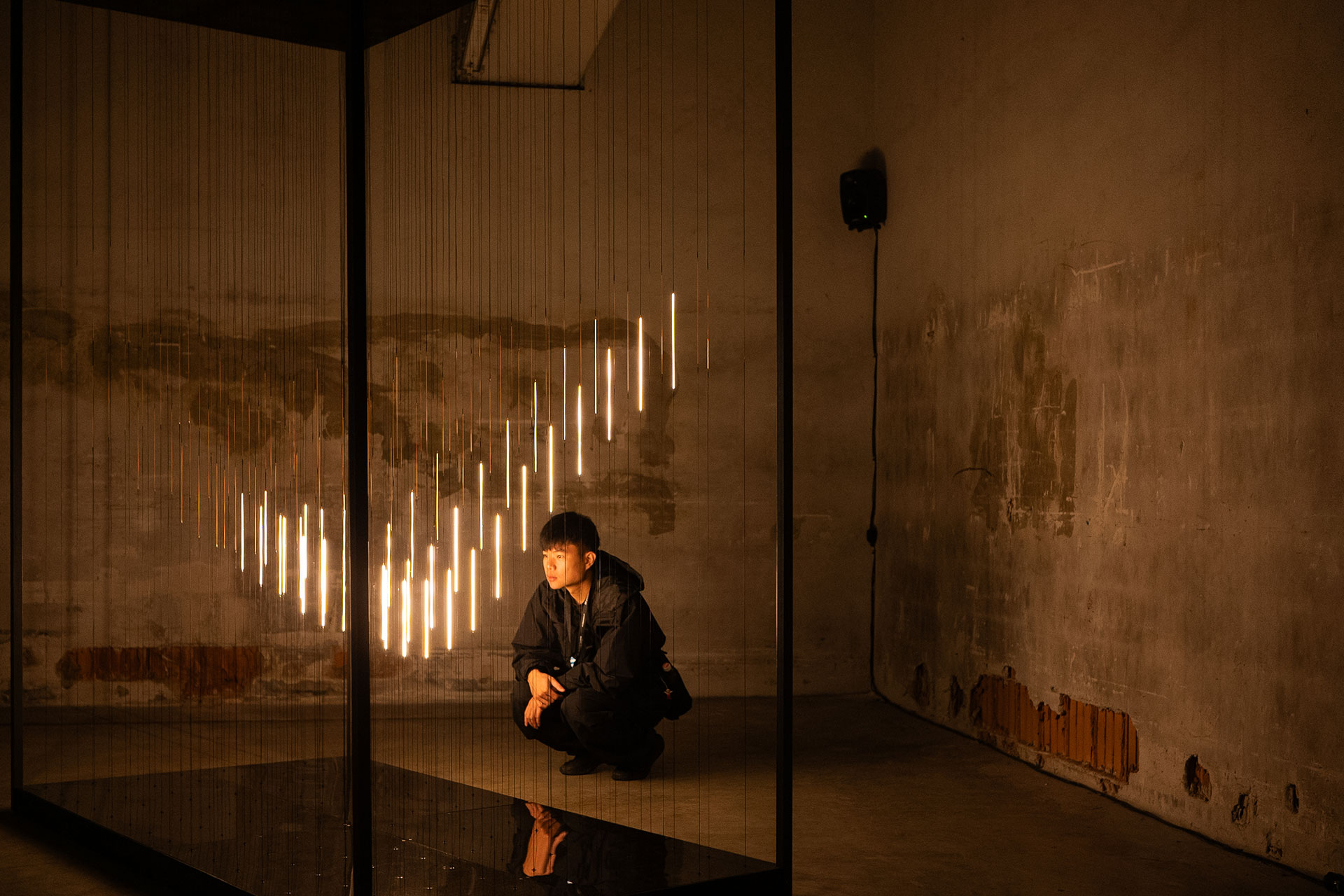
The creative iteration of Tender Soul of Ocean: recall deepens the symbiotic relationship between humanity and the environment. This work is an installation adaptable to various indoor spaces, composed of numerous modular components that allow it to exhibit diverse configurations based on the site’s characteristics. Through collaboration with the German sound art team Kling Klang Klong, the piece incorporates a speculative future wind field model and audience kinetic sensing. The light and sound are generated by real-time wind data and the participation of the on-site audience. Crucially, the light and sound in the work are generated purely by immediate data computation, using no sampled material. The more audience members present and the more active the interaction, the more distinct the “melody” and “noise” generated by the field become, positioning the audience as co-creators of the climate rhythm.
Tender Soul of Ocean: recall has demonstrated its versatility and adaptability across various locations: in September of this year, a smaller version was exhibited at the Ars Electronica Festival in Austria; subsequently, it presented an infinitely version at the C-Lab Sound Art Festival in Taiwan; and in November, an infinite island-like version was displayed in CMP-inspiration museum Taichung.
Within Tender Soul of Ocean: recall, light and sound are not presented as two parallel and coexisting sensory vocabularies, but rather as forces that mutually attract and continuously generate each other’s actions. They simultaneously extend two temporal dimensions: “real climate” and “speculative future.” Light is always the first to form kinetic energy in the space, instantly mapping the wind’s direction and rhythm, seemingly opening a traversable climate trajectory for the viewer. The intervention of sound, conversely, unfolds from the internal senses; it influences breathing and perceptual rhythm, encouraging viewers not merely to “watch” the space, but to merge into the field and become an integral part of it.
The real-time data of on-site wind force and the dynamic participation of the audience continuously modify the light and sound of the field. Meanwhile, the future wind field derived from climate models, acting as a climate memory that has yet to occur, quietly permeates the space and overlaps with the present moment. As the observer’s interaction becomes more active, the emerging rhythm and resonance of the field become clearer, much like an improvisational climate performance where the audience is not standing outside looking in, but rather co-shaping the rhythm of the wind within it.
In this work, our pursuit is not an installation to be merely viewed, but a sensory field capable of self-evolution. Memory is not treated as statically preserved data, but as a state of continuous generation: the sea breeze from the immediate environment, the imagination of future climate, and the breathing and action of the observer in the present moment interweave in the field, creating a palpable and resonant present climate.