

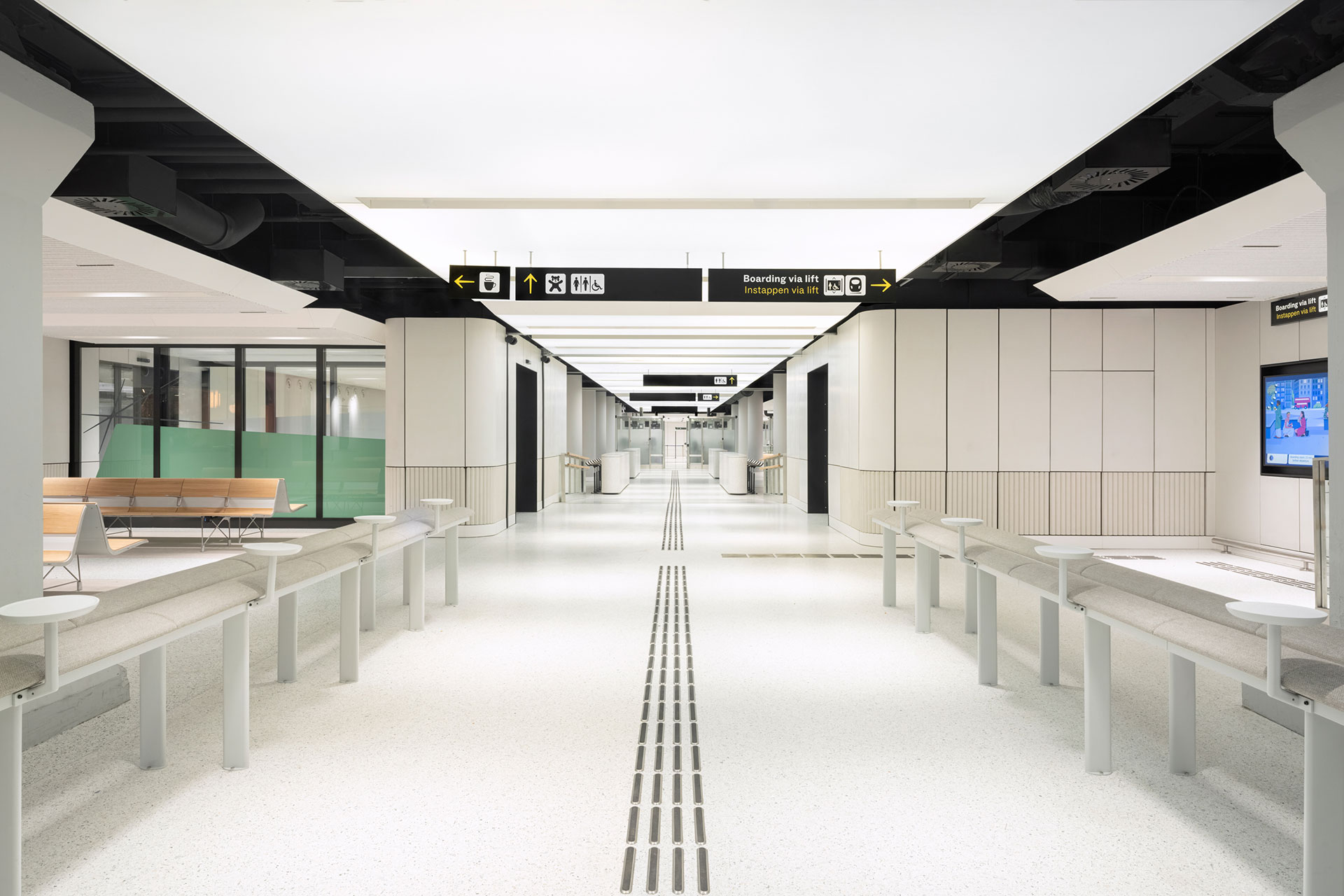
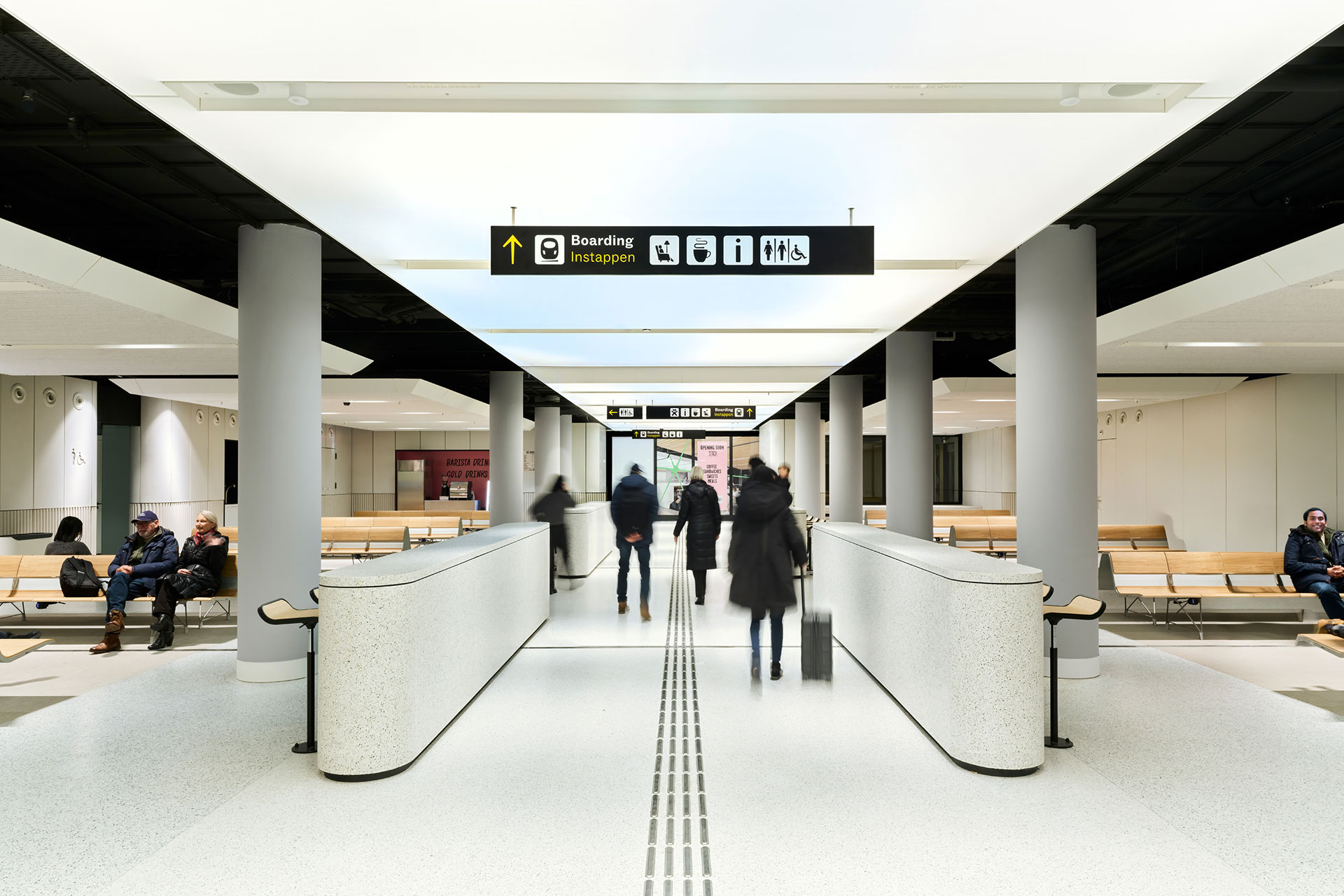
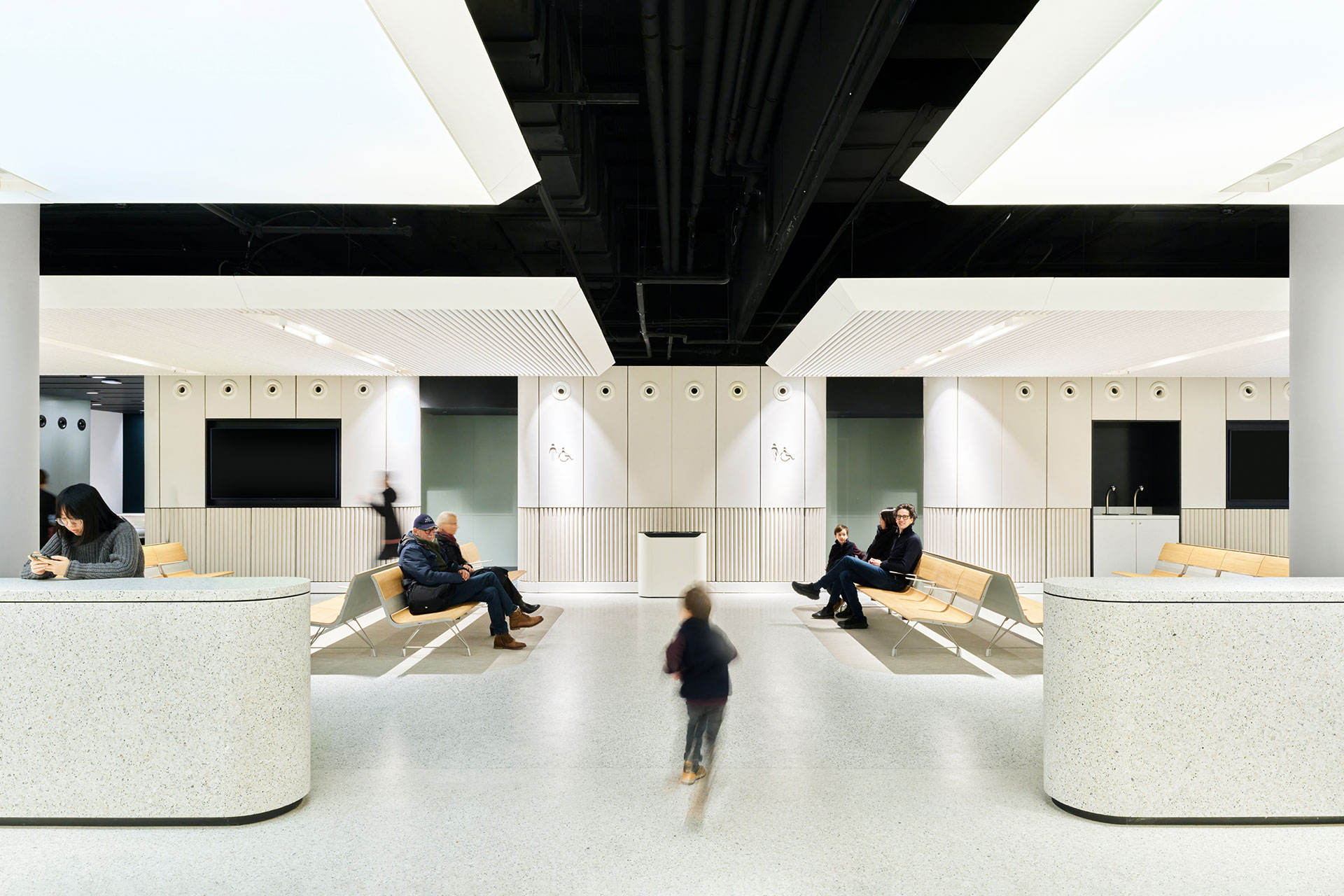
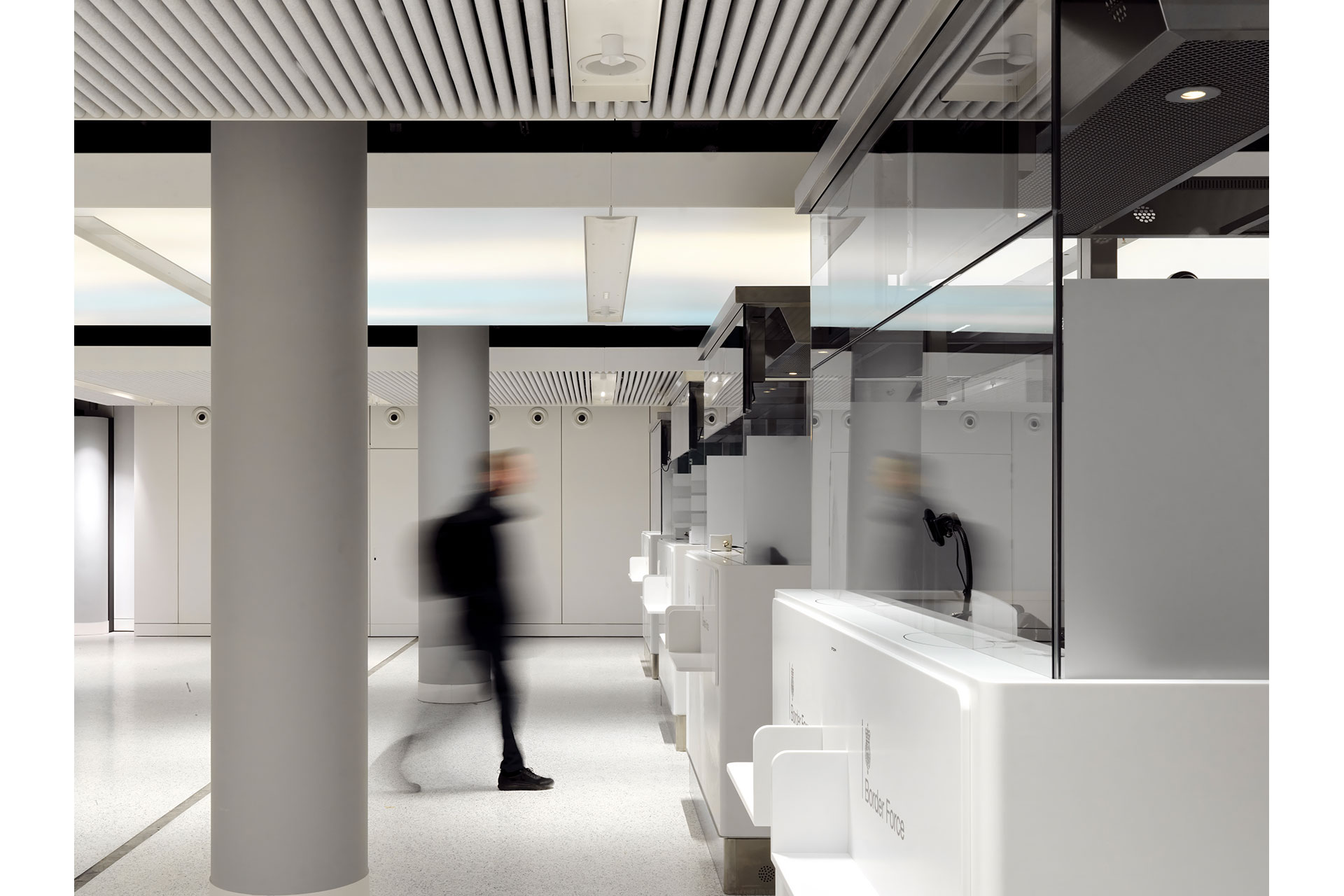
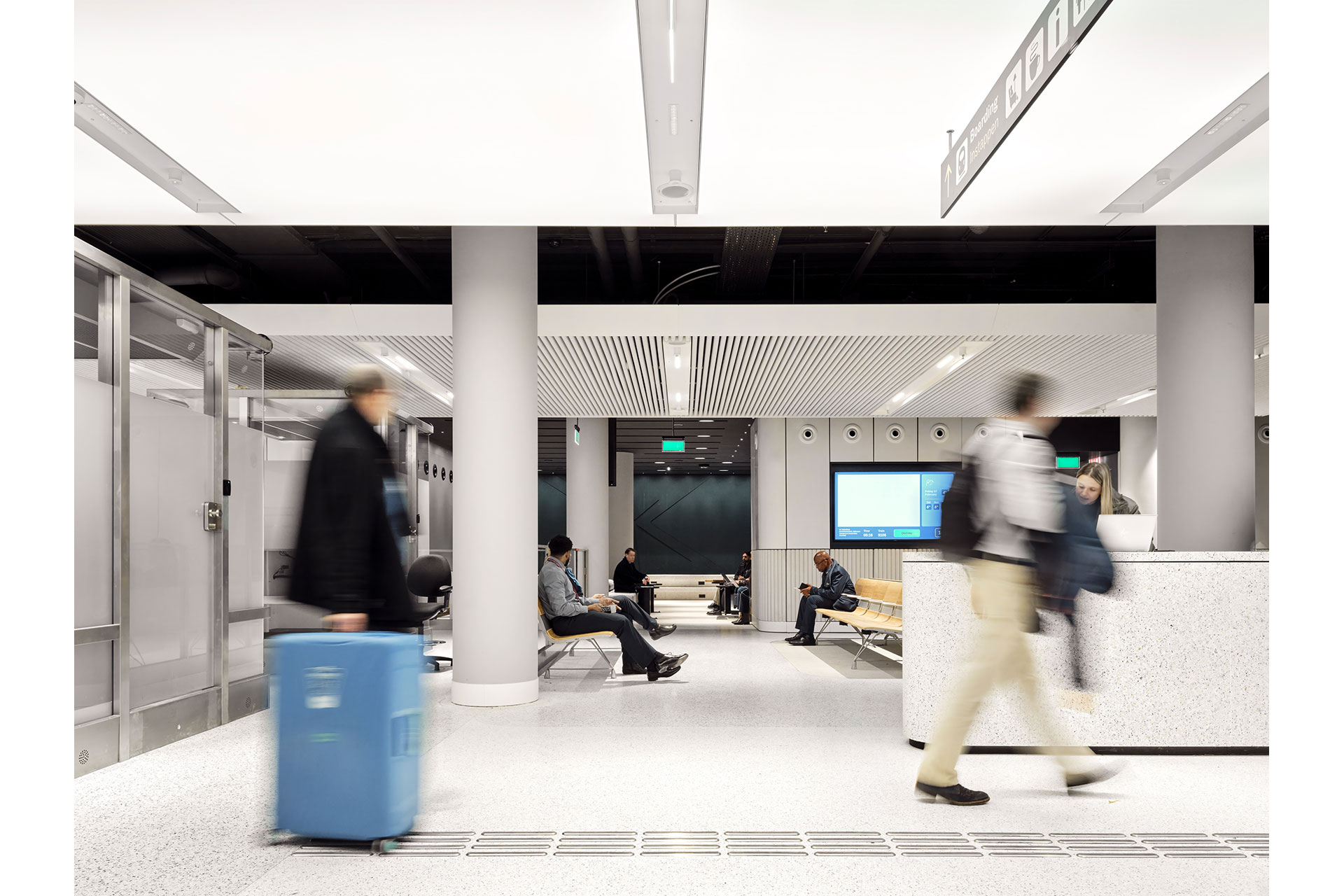
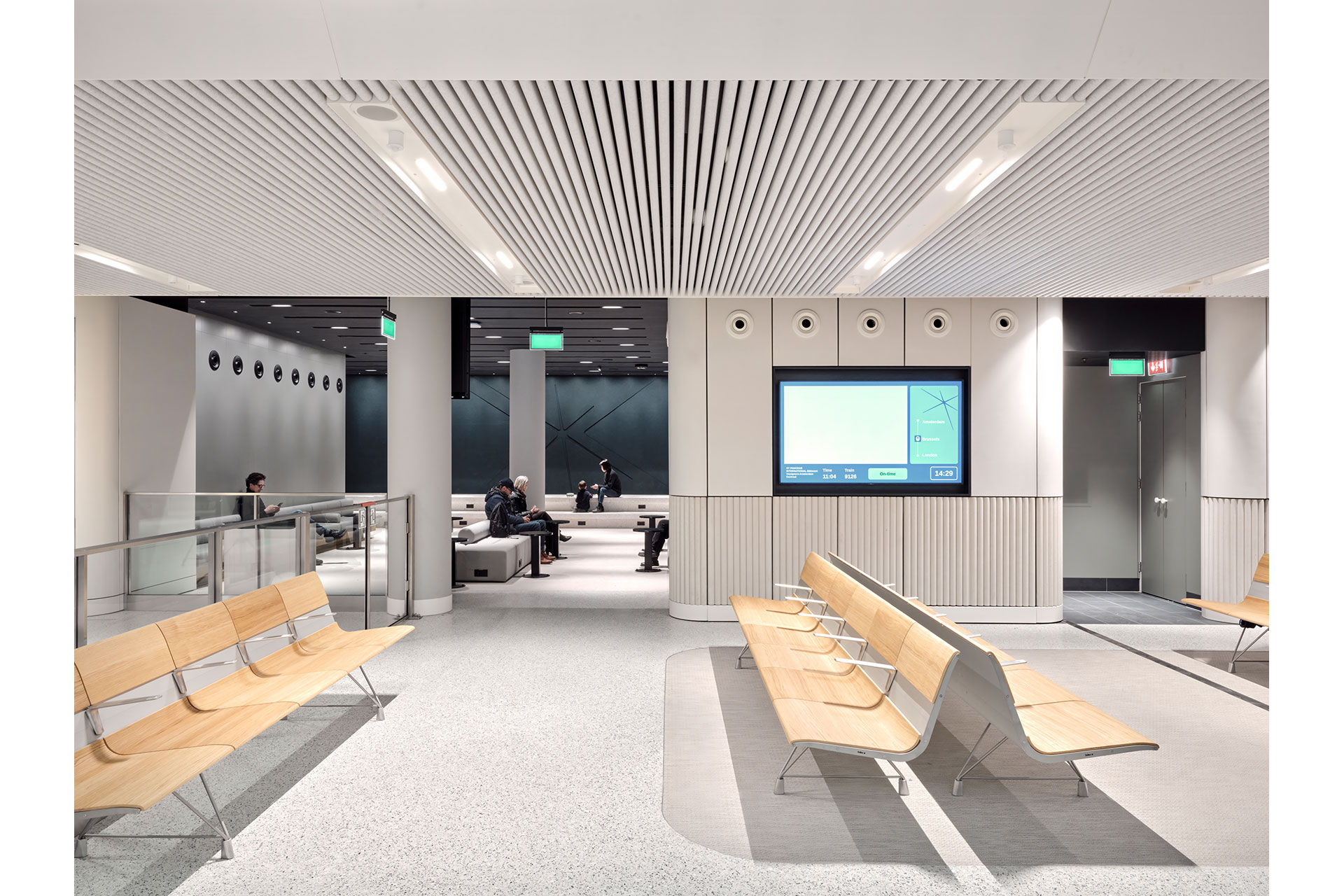
The new Eurostar UK Terminal at Amsterdam Central Station strengthens London-Amsterdam rail links with a spacious, sustainable, and accessible border crossing in the heart of the city.
The terminal is located underneath of the tracks and platforms of the historic building which is a national monument.
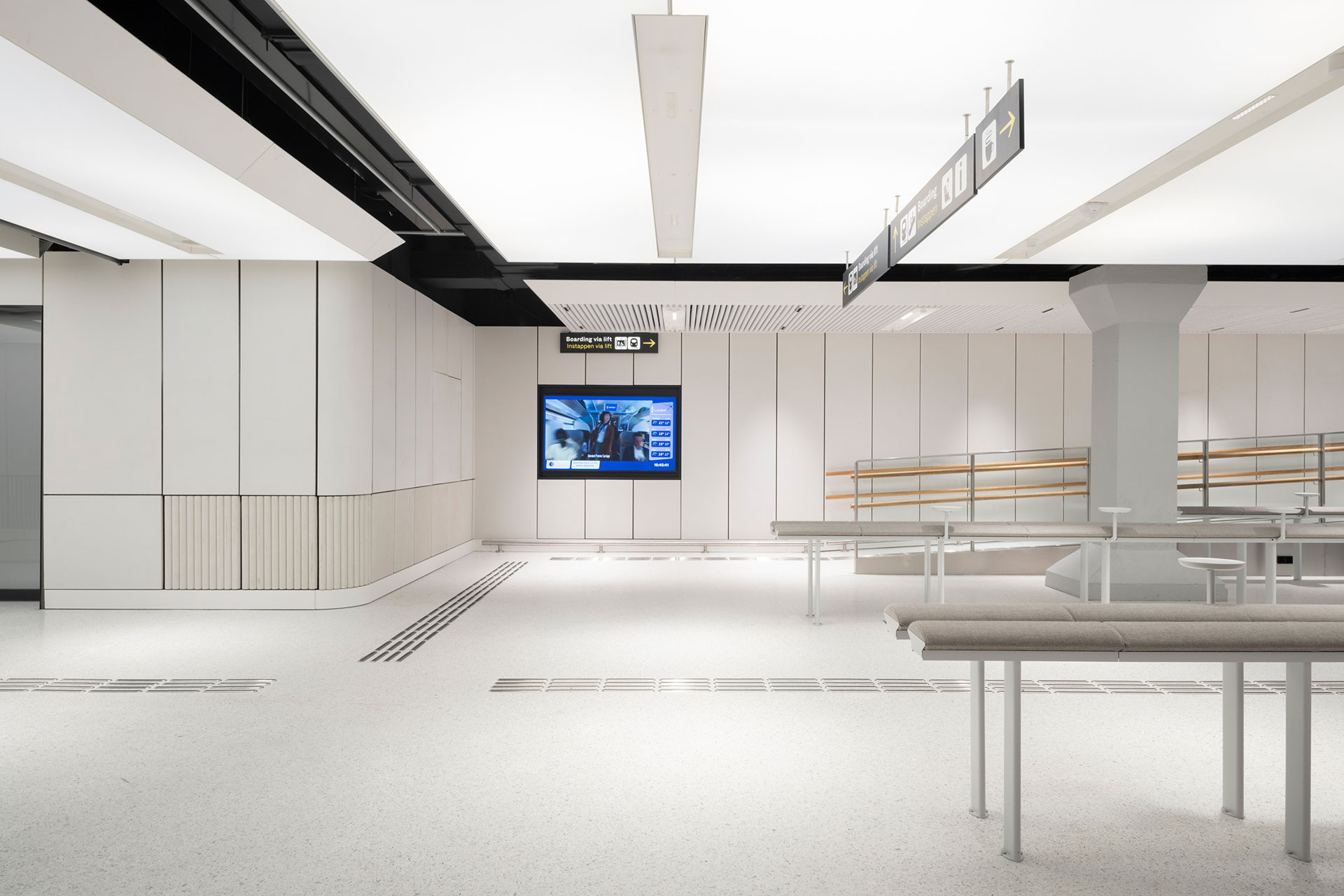
Despite of its location underground the goal of the architects, lighting designers and the design team was to create a bright space and evoke a daylight feeling.
Inspired by Dutch and British masters of Golden Age landscape paintings, the famous ‘cloudy skies’ have been translated into an iconic ceiling, strengthening the identity of the terminal.
An impressive, forty-seven meter long luminous ceiling stretches all the way from customs to the historic columns and brick wall and creates a pleasant and dynamic atmosphere. It reveals moving clouds with varying speed, shapes, hue and intensities, just like real Dutch skies. The level of movement and brightness is connected to the various stages of the boarding process, e.g.: floating clouds start drifting and brightness increases when the train arrives. In fact, the dynamics of the light communicates when the train arrives, when boarding starts etc.
It supports in a subtle way the communication and creates a pleasant daylight atmosphere for passengers awaiting their train.
The continuous ceiling is built up of more than twenty frames with a double membrane and a carfully distributed number of 5000 individually addressable, tunable white LEDs. By programming the LED pixels in a certain way, the pixel patterns truly create an impression of a dynamic sky with moving clouds. Using white LEDs only the contrast between warm and cold white light evokes a surprisingly convincing sense of color, which at times really turns the background blue and the clouds warm white.
On top of the LEDs acoustic wool has been added which acts as a reflector and which can be removed for maintenance.
To complement the diffuse lighting from the luminous ceiling and enhance the spatial experience of the terminal as a whole, recessed luminaires with narrow beams have been integrated into the luminous ceiling. They provide an appropriate amount of contrast and shadows. These luminaires are programmed independently from the clouds, establishing a connection between the adjacent spaces and the luminous ceiling in pre-set scenarios.
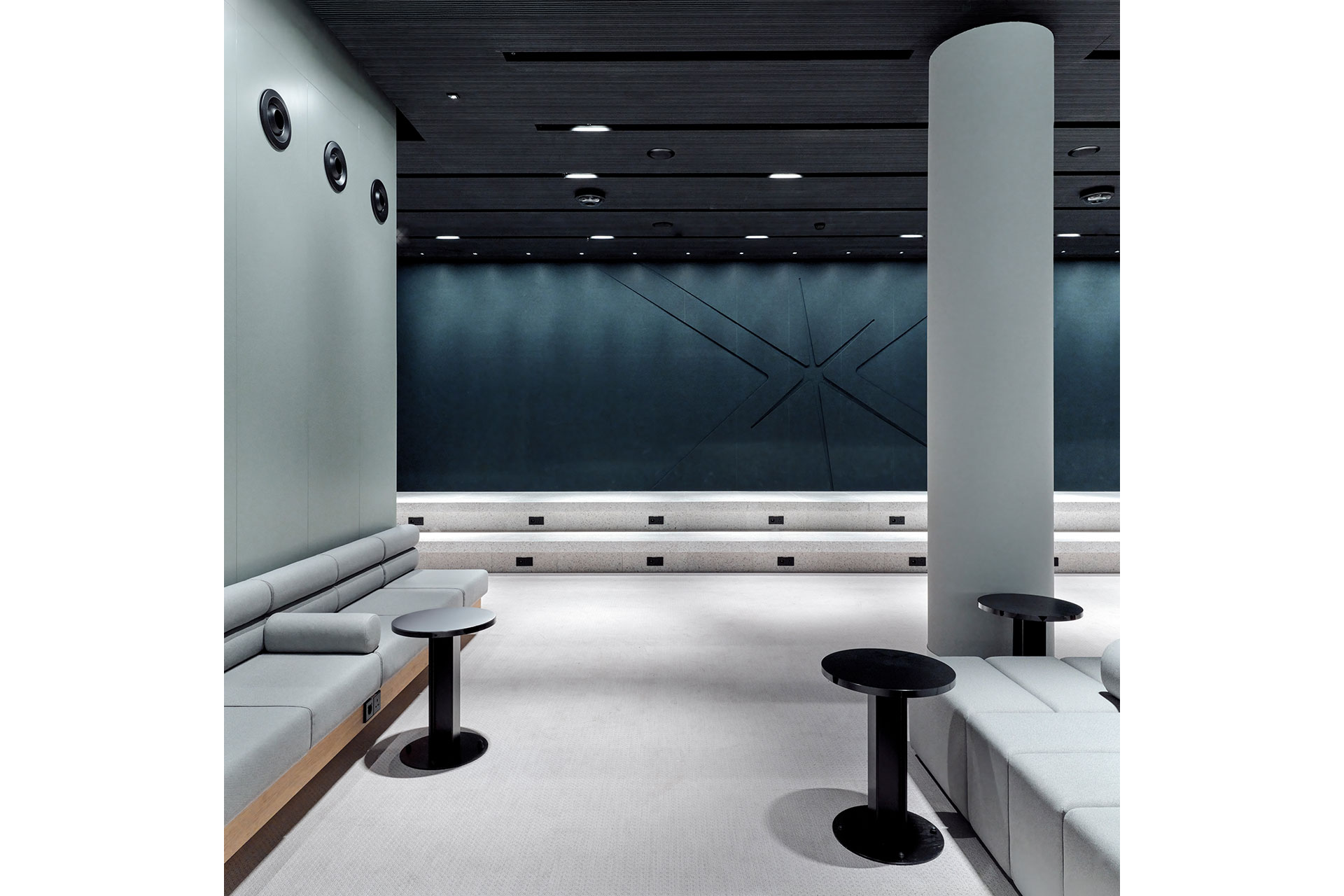
The adjacent spaces are lit with a combination of wide – and narrow beam ceiling luminaires, neatly integrated in the felt ceiling slats. The ratio between general light and higher contrast light changes depending on the scenario, as well as the light intensity. Finding the right balance for the adjacent spaces has been key for the spatial experience of the terminal as a whole.
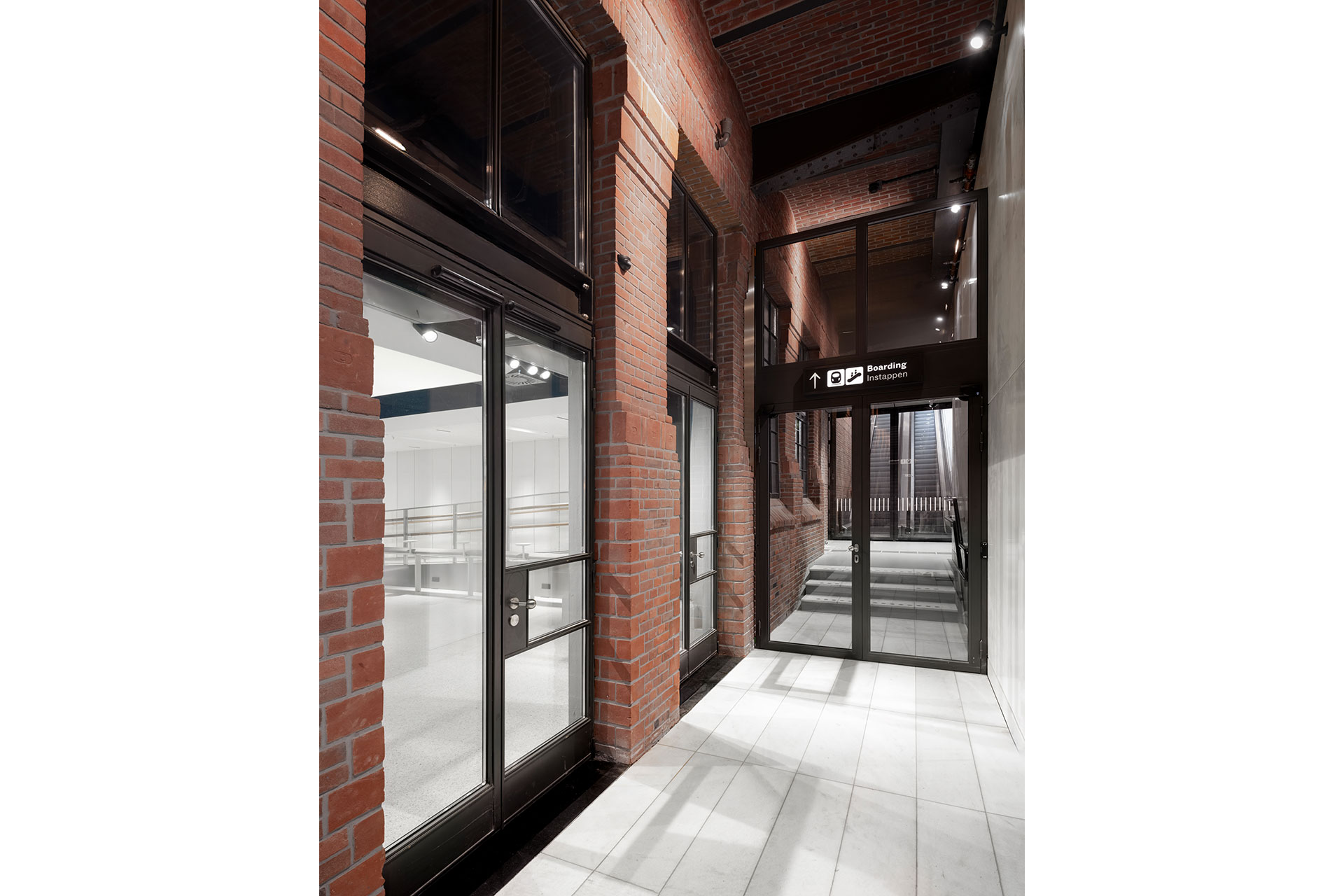
Historical elements like iron columns and the historical brick wall have been highlighted in accordance with the overall vision for the monument. Passengers ascending to the platforms glide along a beautiful historic brick wall via escalators and staircases. Together with the vaulted ceiling the wall is a remarkable architectural element and supports orientation and wayfinding by the way it is lit.